Vision
A game company that runs itself.
The aim: design, production, testing, live operations and support carried out by AI agents end to end, so the studio keeps making and running games even on days when nobody is at the desk.
Game Gum Studio · Hanoi, Vietnam
Game Gum is a two-person game studio built around AI agents. Agents write the code, build the models, rig the animation and test the builds, so a new idea becomes a playable game fast. A person decides what is good enough to ship.
The studio
The name is the goal: making a game should feel as easy as chewing gum. The hard, repetitive parts (code, art production, testing, operations) go to a pipeline of agents that does not get tired. That leaves time for the part that matters: trying ideas, dropping the ones that don't work, and trying new ways of making games.
Vision
The aim: design, production, testing, live operations and support carried out by AI agents end to end, so the studio keeps making and running games even on days when nobody is at the desk.
Mission
Agents are how we get more done and hold a higher bar, never an excuse to lower it. Every system gets a design doc, every development phase has an acceptance gate it must pass, and every model, animation and sound in our flagship game is original work made for that game.
Capabilities
Over more than 11 years in games, the founder has worked hands-on in each of these seven areas, and each one now has agent tooling built around it.
Gameplay, UI and core frameworks in C# and Unity, from FPS/TPS shooters and 3D auto battlers to casual, hyper-casual and hybrid mobile titles. Work includes reusable Unity packages (Addressables loading, event tracking, device identity, CRM), shader work in HLSL, ad-monetization and web-store payment integration, and optimizing the code of games already live in the stores. Current projects run on Unity 6.
At Sabo Game: game servers in C# on .NET Core for MMORPG projects, tuned for thousands of concurrent players. Earlier: shooter gameplay on both client and server, including bot and AI opponents, and the auto-battle system of an auto battler on client and server. On Isle of Dreams (Node.js): an authoritative simulation the client cannot overrule, client prediction with reconciliation, gold and item ledgers that reconcile exactly, and bot load tests before players arrive.
Leading game teams as team lead, project manager, product manager and producer since 2021: MMORPG teams today, casual and hybrid mobile teams before that, and a 3D blockchain game delivered on a very short timeline. Mentoring developers into full-stack MMORPG engineers, and supporting 3D artists, animators and effects artists on asset production. Today the same job also means organizing AI agents: splitting work into tasks, routing each one to the right model and effort level, and putting human approval at the points that matter.
3D maps for FPS/TPS shooters. Today: toy-style characters, monsters, props and environment kits built procedurally in code, each monster species in three evolution stages that keep a recognizable silhouette. Around that: a local image-to-3D backend that runs on a 6 GB graphics card, retopology and sketch-to-mesh tools in C++, a searchable 3D asset library for Unity with AI labeling, and a tool that turns top-down concept art into a laid-out Unity scene.
2D skeleton animation in Spine and 3ds Max for casual games, animation for FPS/TPS shooters, and model, texture, animation and shader work for 3D auto battlers. Today: procedural rigs and motion for heroes, monsters and mounts, plus retargeting of humanoid clips onto custom skeletons through a bone driver.
VFX for FPS/TPS shooters. Today: real-time effects on a strict performance budget: attack telegraphs that stay readable as monsters get stronger, projectile and area effects rendered with instancing, weather, and ambient effects per biome (sun shafts, marsh steam, drifting fog, embers, cloud shadows) planned at no more than three extra draw calls.
Systems, economy and level design, written down before they are built. Combat with damage types, seven elements and status effects; monster evolution rules with a danger budget per stage; player economies checked by a 10-week simulation for inflation; floor and quest structure; story bibles; and a level-design workbench with difficulty models, test bots and a design advisor. Earlier: a first job as a game designer on casual games and a third-person tank shooter, gameplay features for FPS/TPS shooters, and PvE and economy design for a 3D tower-rush card battler.
Games
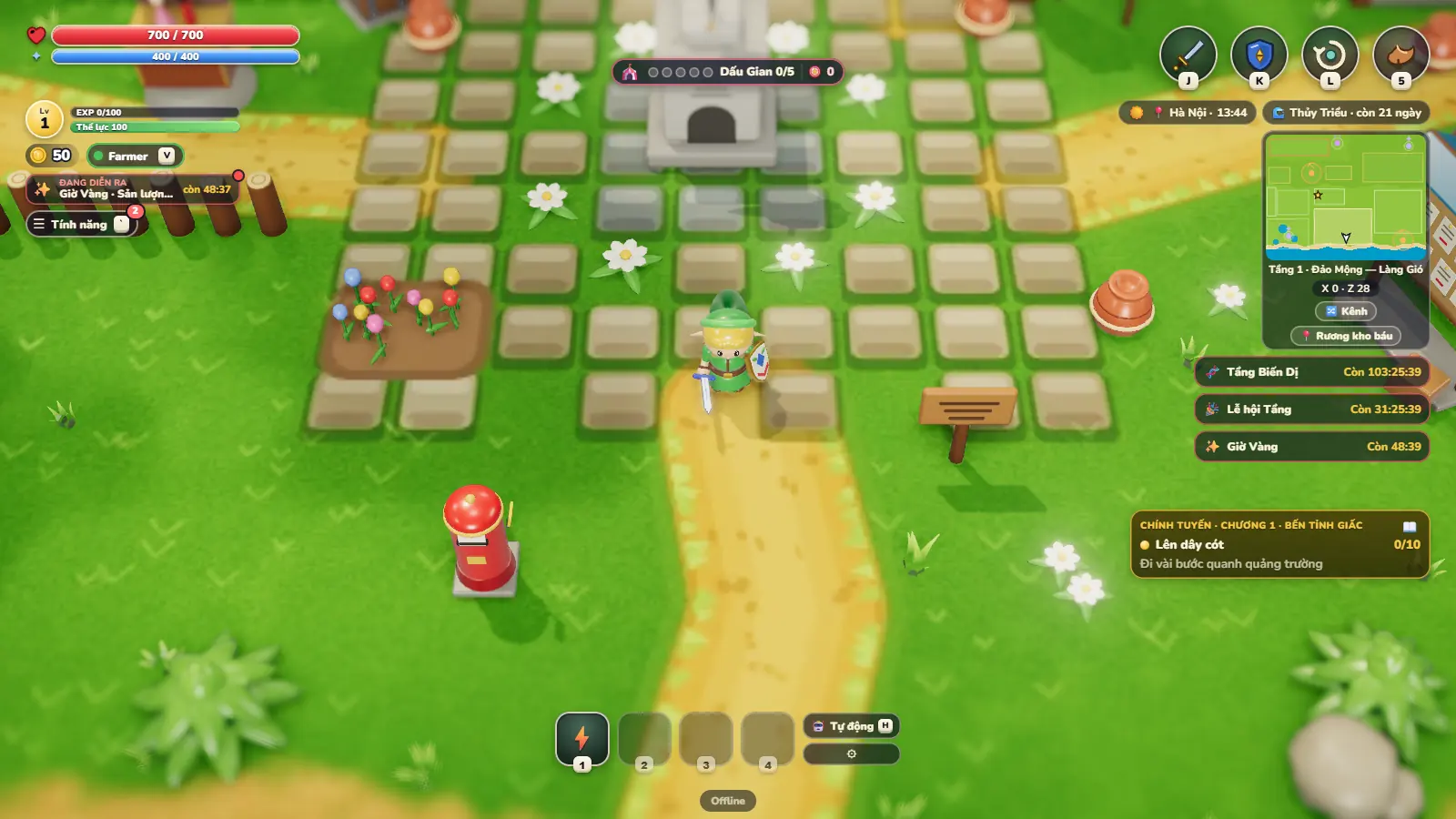
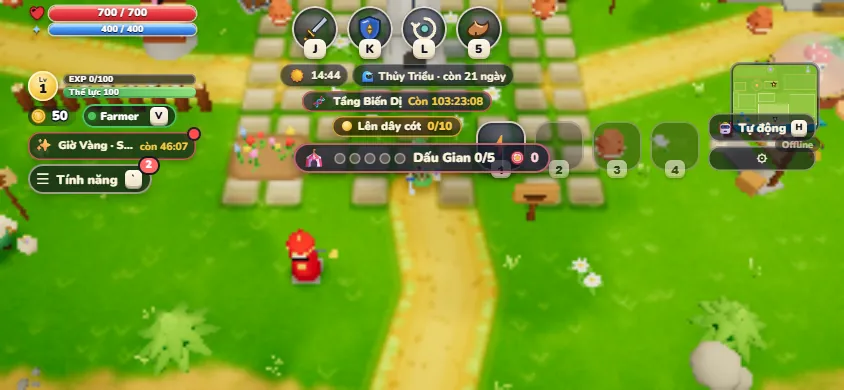
UI shown in Vietnamese.
Flagship · Playable online · In development
An online action-adventure set on a toy diorama.
Isle of Dreams is an online action-adventure game in a glossy toy-diorama style, built with Three.js and an authoritative Node.js game server. Every model, animation, effect, sound and piece of music in it is procedural and original.
The world is a giant toy table broken into floating floors. Players climb from floor to floor, farm and fight in three combat modes, mine, solve puzzle shrines, trade on a shared market, craft and upgrade gear, and beat a Gate guardian to open the next floor. Monsters evolve through three stages, and each stage hits harder in new ways while keeping its own attack style.
The plan is for Isle to grow itself, with the players in charge. The whole loop will happen inside the game, as part of playing it:
The goal is for players to approve what ships, so the game can keep developing even when its founder is not around.
In development The in-game Roadmap board is live; proposals, voting and the builder agent come next.
Process
Projects run through one agent pipeline built on Claude Code. Claude agents do the work, and a person signs off at three points: the plan, the result and the rollout.
The lead agent explores the idea, then asks the questions that change the outcome before anything is built.
It writes a plan with acceptance criteria and a task table showing which model and effort level runs each task. Nothing starts until a person approves the plan.
Subagents run the tasks inside the approved plan. The orchestrator reviews their short reports, not their raw output, and the person can change direction mid-run.
A separate Claude review pass checks results against the acceptance criteria: tests, load runs, simulations, screenshots. A person then accepts the work or sends it back.
Deployment, DNS changes and anything else that cannot be undone wait for an explicit go-ahead.
Run logs feed back into routing, so each project teaches the pipeline which Claude model and effort level to use for which job.
Our stack
Claude does most of the work in this studio. We use Claude Opus and Claude Sonnet every day, at every stage of production: mainly through Claude Code, and also through third-party coding tools that run on Claude.
We use agents to raise quality as well as output, so what we ship is the opposite of AI slop.
Founder
Founded by Trung-Kien Nguyen, who has worked in games for more than 11 years, since 2015: game design, FPS/TPS shooters, auto battlers, casual and hybrid mobile games, a blockchain game and MMORPGs. Hanoi, Vietnam. LinkedIn
Jul 2024 – present
Building the studio, its agent pipeline and Isle of Dreams. Game Gum is incubated by a partner game studio.
Jul 2024 – present
Leads MMORPG development: Võ Lâm GenZ, plus outsourced builds delivered and handed over to clients (a MU Online title, Kiếm Vương Origin). Game servers in C# on .NET Core; client and server optimized for thousands of concurrent players and large-scale rendering. Mentors full-stack MMORPG developers; provides technical direction, pipelines, workflows and tools across teams.
Mar 2023 – May 2024
Frameworks and core modules for game development in Unity; optimized code of released games; technical consulting on game projects.
Apr 2022 – Feb 2023
Led a team making casual, hyper-casual and hybrid mobile games; technical consulting and tools for other teams on product development, ad monetization and digital advertising.
Sep 2021 – Mar 2022
Led development of Doragon Land, a large-scale 3D NFT tower-rush and card-battle game, on a very short timeline: production planning, the PvE mode and parts of the in-game economy.
Aug 2020 – Oct 2021
Led a casual and hybrid games team that released several titles, including Royal Defense: Zombie War (turret defense) and Scary Neighbour – Prank Master (top-down hide-and-seek).
May 2020 – Jul 2020
Built and polished battle features for the auto battler Heroes & Empires: Idle RPG.
Aug 2019 – May 2020
Casual games built solo, gameplay prototypes, and features for a gamified banking app.
Sep 2018 – Aug 2019
Core gameplay design and development for 3D mid-core auto battlers I Am Hero and Auto Chess Legends: battle mechanics, game data config, asset management, and creating and optimizing models, textures, animations and shaders.
Jun 2016 – Aug 2018
Gameplay features on client and server for FPS/TPS mobile shooters Biệt Kích Mobile, Bullet Strike: Battlegrounds and Bullet Strike: Sniper PvP; bot and AI opponents; 3D maps, animation and VFX.
Mar 2015 – Apr 2016
Designed and built casual games; 2D skeleton animation with Spine and 3ds Max; a third-person tank shooter and a first-person sniper prototype. Started programming here, on the games themselves.
Projects
Alongside Isle of Dreams, the founder has built a set of agent and production tools during 2026 with Claude Code. Game Gum is incubated by a partner game studio. These tools were built for both studios and are in production use at the partner studio today. Most are internal, so there are no public links.
Contact
Questions about Isle of Dreams, how we build with Claude, or working together: write to us.
Founder & CEO: Trung-Kien Nguyen · LinkedIn